

Imagine an OEM connectivity rollout reaching a new market. A vehicle registers on the local mobile network and appears online, but the driver’s remote command times out after the vehicle wakes from sleep. The operator sees a valid connection. The backend team sees a request it sent. The launch team still needs to know where the command stopped and whether the fault affects the vehicles it is about to release.
1. Suppliers validate their components separately
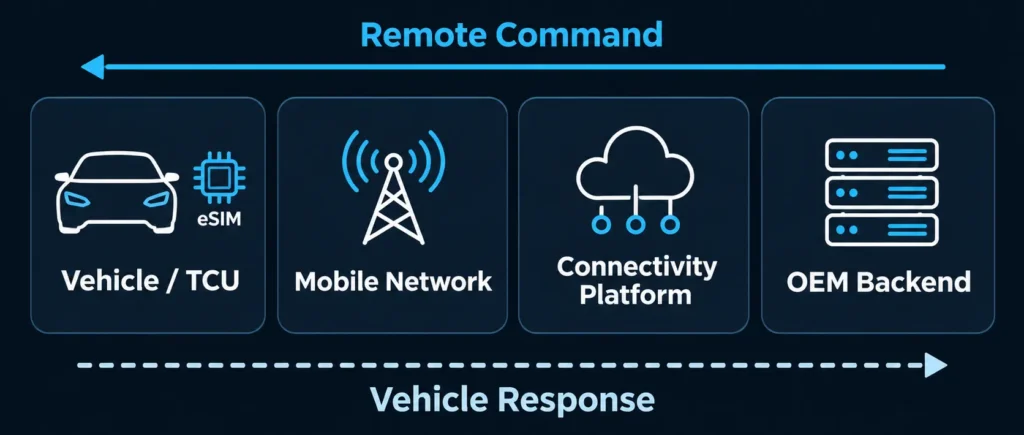
The vehicle connectivity hardware supplier can verify that the modem establishes a network connection, whether through a dedicated telematics control unit (TCU) or a more centralised software-defined vehicle architecture. The provisioning provider can confirm that the correct eSIM profile is active, while the backend team can verify that a remote command was sent.
However, the OEM still needs to validate the complete service chain, from the backend request to its execution in the vehicle and the response returned to the customer application.
2. eSIM activation works in the pilot, but profile recovery is untested
A successful download shows that one profile reached one device under the tested conditions. A market launch raises other questions.
Can the vehicle reach the provisioning platform on first activation? What happens if a download is interrupted? Can the team restore connectivity if an enabled profile cannot reach the intended network?
GSMA SGP.32 defines how compatible IoT devices can receive and manage eSIM profiles remotely. For automotive OEMs, that can support a shared vehicle hardware design across markets while allowing a suitable local operator profile to be enabled where needed. It can also support profile changes after production without replacing the SIM. The rollout team still needs to verify initial connectivity, profile activation, and recovery on the intended vehicle and network.
3. The OEM connectivity rollout relies on unverified network access
A country on a coverage list tells the OEM where network access is offered. The launch team needs to establish which operator and profile the vehicle will use there and whether the services it plans to sell work on that combination. For example, a data session may return after a coverage gap while telemetry has yet to resume.
Network selection also depends on what is permitted for long-term use. Brazil and Türkiye are examples of markets where permanent roaming restrictions or local eSIM rules can affect the deployment model. Confirm whether the intended setup requires a local operator profile, then validate registration, roaming, reconnection, and service recovery on the networks the vehicle will use.
4. Test results belong to a different configuration
A firmware update, backend release, or profile change can make an earlier pass less useful. If a remote service stops working, the team needs to know which hardware, software, profile, and network produced the original result. Otherwise, it can spend time trying to reproduce a failure on the wrong setup.
Repeat the critical scenarios on the configuration scheduled for release. With remote access to a physical test bench, engineers can compare firmware versions and inspect diagnostic traces without travelling to the test location.
5. Bench tests leave gaps in real-network behaviour
A bench gives engineers repeatable conditions for diagnosing problems. Live network testing shows how the same service behaves with the coverage, roaming, and operator configuration it will encounter after launch.
For example, engineers can reproduce a wake-up failure on a remote bench and compare two firmware versions. They can then verify the correction on the intended operator under the conditions that prompted the issue. Horizon Connect combines both forms of validation so the OEM has evidence of the fix and its behaviour in the target market.
6. The global plan leaves local service requirements unresolved
A shared vehicle platform can support several markets, while each market may set its own requirements for services such as emergency calling. In the EU, Regulation (EU) 2015/758 addresses public 112-based eCall within its defined vehicle scope. Saudi Arabia has its own vehicle eCall standard, SASO 2944:2023, scheduled to become mandatory on 1 January 2028.
Public eCall, private SOS, and roadside assistance can use different receiving endpoints and service arrangements. Each needs validation appropriate to its intended call path, including voice and emergency data delivery where required. For a closer look at operator coordination and testing in the region, see our guide to eCall and NG-eCall deployment in the GCC.
For eCall and NG-eCall programs, Horizon Connect helps translate applicable requirements into integration and validation work. That can include coordinating with operators and service partners, checking the intended receiving endpoint, and capturing evidence of voice and emergency data delivery where required. The OEM can see what has been verified for the deployed configuration and which interfaces still need attention.
7. The launch team sees the fault but cannot reproduce it
“Vehicle offline” can describe a loss of coverage, a provisioning issue, or a failure elsewhere in the service. Without a common record of the timestamp, vehicle software, active profile, and serving network, each team may investigate a different set of conditions.
Horizon Connect helps OEM teams establish a shared diagnostic workflow, reproduce problems on the relevant setup, and escalate issues with the technical evidence the receiving team needs. When a correction is available, the affected scenario can be rerun before the next release decision.
In practice: Global connectivity validation for a premium automotive OEM
A premium automotive OEM faced challenges validating connected services across different hardware configurations, firmware versions, mobile networks, and countries. Reproducing certain connectivity issues required physical access to specific testing environments, creating dependencies between geographically distributed engineering teams.
Horizon Connect addressed these challenges by combining remote access to physical test benches with real-network testing and structured diagnostics. This enabled engineers to reproduce issues remotely and investigate failures across the vehicle, mobile network, and backend. Read the OEM case study.
Prepare your next OEM connectivity rollout
If you’re planning a market launch or investigating a connected service that behaves differently across countries, share your vehicle platform, target markets, and services in scope. We can review the affected interfaces with your team and help define what needs to be integrated, tested or escalated before the next release decision.