

Launching vehicle emergency calling in the GCC requires a deployment plan for each country. OEMs need to identify the applicable eCall rules, complete telecom equipment approvals, establish the call route with operators and service partners, and validate the production configuration.
Drawing on Horizon Connect’s connectivity testing experience in Saudi Arabia, Oman and the UAE, this article explores the technical and operational challenges OEMs need to address before launching emergency-calling services in the region.
Define the emergency service before integration
Legacy eCall combines an emergency voice call with a Minimum Set of Data (MSD), traditionally transferred through an in-band modem over a circuit-switched network. NG-eCall uses IMS and packet-switched communication to carry the emergency call and associated data. Voice remains part of the service.
A private SOS service reaches an OEM or third-party service centre, which may then coordinate with emergency authorities. Breakdown assistance is a separate service. These service models must be distinguished from public eCall routing; a successful private SOS or assistance call does not demonstrate public NG-eCall conformity.
Likewise, LTE or 5G connectivity, ordinary VoLTE calling and a successful data session do not establish that IMS emergency calling and MSD delivery work through to the intended answering point. Each service path needs its own acceptance evidence.
Validate the interfaces with operators and service partners
The integration plan should assign an owner and an acceptance test to each interface:
- TCU and SIM or eSIM: active profile, subscription identity, provisioned services and the intended domestic or roaming configuration.
- Mobile operator and IMS: emergency registration and session establishment where applicable, SIP signalling, voice media, serving-network routing and callback handling.
- Receiving endpoint: the public emergency route or private service-centre destination, with separate evidence for voice connection and emergency-data reception.
- OEM and connectivity backend: device registration, profile operations, B2B interfaces, country datasets and trace correlation.
For private SOS and assistance calls using ordinary telephone numbers, include international calling permissions, destination allowlists and return-call reachability. Public emergency calling follows its own emergency-service procedures; private-number permissions must not be treated as the mechanism for public emergency access.
For multi-operator deployments, repeat critical call tests for the intended operator and profile combinations. Remote profile provisioning and emergency-service continuity require separate validation.
Build the test plan around the deployed configuration
Select the applicable conformance and interoperability tests, then add the country, operator, and backend scenarios required by the deployment. ETSI TS 103 683 provides NG-eCall interoperability test descriptions; the exact standards and editions used for approval must follow the applicable national requirements.
| Test area | Evidence to capture |
| Trigger and destination | Manual and automatic triggering where applicable; correct receiving endpoint; call establishment and callback. |
| Voice and emergency data | Two-way audio; MSD reception and decoding where required; vehicle identity, position, timestamp and data acknowledgement. |
| Access and roaming | Each intended operator, profile and access technology; weak or lost coverage; reattempts and supported fallback. Fallback depends on the actual networks available. |
| Provisioning and recovery | Device registration, operational-profile download, relevant B2B calls, backend recovery and repeated sleep/wake cycles. |
| Failure handling and retest | Rejected or unanswered calls, interrupted sessions, invalid data, and retesting after software, profile, or routing changes. |
Use designated test endpoints or prearranged sessions with the receiving organisation. Record the software version, country dataset, operator, active profile and timestamps with the vehicle, network and backend traces. Keep passed, failed, blocked, and unexecuted cases distinct.
Separate compliance from deployment acceptance
Maintain separate records for vehicle eCall conformity, telecom equipment approval, operator and service-partner integration, and operational validation. Each record answers a different release question.
Saudi Arabia illustrates the distinction: removing the PSAP test from a conformity procedure does not remove the manufacturer’s responsibility stated in the SASO circular. As an engineering release criterion, the actual emergency service path still needs validation appropriate to the intended deployment.
European 112-based requirements and international technical standards provide evidence within their defined scope. Their use must be mapped to the national approval route and the service actually deployed in each GCC country.
Real-World Example with German Premium Automotive OEM
During the rollout of connected vehicle services in Saudi Arabia, Oman and the UAE, a German premium automotive OEM required local engineering support to validate its connectivity systems under real-world conditions.
The Challenge: Although the vehicle’s connectivity architecture was already developed, differences in local operator configurations, service routing and backend integration created challenges that could not always be reproduced in laboratory environments.
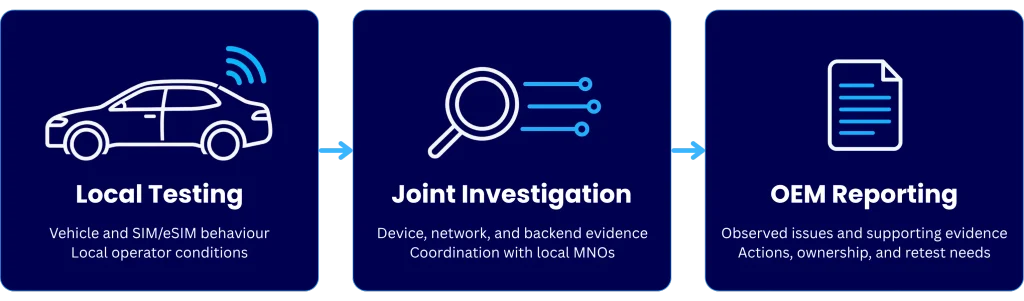
Horizon’s Approach: Horizon Connect provided on-the-ground engineering support, working directly with local MNOs and central OEM teams to test connectivity, investigate network-specific issues and coordinate troubleshooting activities.
The Outcome: The engagement helped identify market-specific connectivity issues, coordinate their resolution and provide the OEM with structured technical reporting to support deployment readiness.
How Horizon Connect supports OEM deployment
Horizon Connect combines connectivity engineering expertise with an established local presence in the GCC, enabling OEMs to validate and deploy connected vehicle services directly in their target markets.
Our support covers TCU and SIM/eSIM integration, real-network testing, MNO coordination and troubleshooting, as well as the operational logistics required for local testing, including equipment handling, customs documentation and temporary imports.
With local engineering resources and testing infrastructure, we help OEMs identify integration issues, coordinate corrective actions and validate market readiness without having to deploy their own teams.
Planning an eCall or NG-eCall deployment in the GCC? Contact Horizon Connect