
SDV integration connects every layer of a connected vehicle service—from sensors and ECUs inside the vehicle, through the TCU, eSIM and mobile network, to cloud services, the OEM backend and the customer application.
Every part of this chain can work correctly on its own, while the complete service still fails at the handover between two systems.
This is why integration must be managed end to end. For OEMs, the goal is not simply to connect more platforms. It is to make the complete service deployable, observable and reliable throughout the vehicle lifecycle.
What End-to-End SDV Integration Means
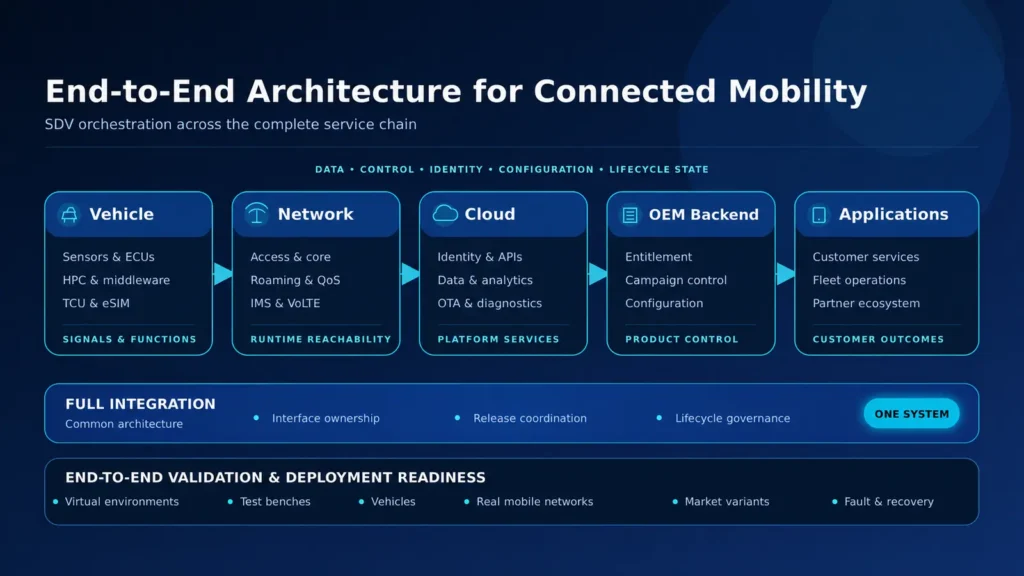
The figure shows five connected domains: vehicle, network, cloud, OEM backend and applications. They are not independent layers. Data, identity, configuration and lifecycle state move across the complete chain.
The vehicle generates signals and executes functions. The mobile network provides the communication path between the vehicle and off-board services, subject to coverage, roaming and service availability. In a typical OEM architecture, cloud platforms support data processing, APIs, diagnostics and update delivery, while OEM backend services manage vehicle identity, entitlements, campaigns and configuration. Customer and fleet applications expose these capabilities to users.
Full Integration connects these domains through a common architecture, clear interface ownership, coordinated releases and shared lifecycle governance. The result is one operational system instead of several isolated technical components.
Where SDV Integration Can Fail: Cross-Domain Interfaces
Many SDV problems do not begin inside one component. They appear between teams, suppliers and technologies.
- The vehicle software is ready, but the TCU or eSIM has the wrong market configuration.
- The vehicle connects to the network, but roaming or quality-of-service conditions prevent the service from working correctly.
- The cloud API is available, but the vehicle identity, certificate or customer entitlement is inconsistent.
- One system is updated, while a dependent backend or application still expects the previous version.
- A problem is visible to the customer, but the required logs are separated across different domains and suppliers.
These are not isolated component failures. They are end-to-end service failures. Solving them requires one view of the full chain.
How Full Integration Connects the SDV Ecosystem
Horizon Connect’s Full Integration approach brings the complete service chain together from early architecture decisions to market deployment and ongoing operations.
- Design and align: The first step is to define how the customer-facing service should work across the vehicle, connectivity, cloud and backend domains. Requirements, interfaces, identities, configurations and responsibilities must be clear before late integration begins.
- Integrate and coordinate: Software versions, APIs, eSIM profiles, network settings, certificates and backend rules must be aligned. Cross-domain dependencies need named owners, agreed acceptance criteria and a clear recovery path.
- Validate in real conditions: Virtual environments and test benches are important, but connected services must also be tested with real modules, vehicles and mobile networks. Validation should cover normal operation, weak coverage, roaming, unavailable backends, interrupted updates and recovery after a failure.
- Operate and improve: After deployment, logs and traces from the vehicle, network, cloud and backend should be connected. This helps teams identify the real cause of a problem faster and use field evidence to improve future releases.
From Component Testing to Deployment Readiness
A component can pass its individual test without proving that the complete service is ready for customers. End-to-end validation asks broader questions:
- Does the service work across the target vehicles, software versions, operators and markets?
- Can it recover after coverage loss, roaming changes or a backend interruption?
- Are vehicle configurations, eSIM profiles, identities, certificates and entitlements aligned?
- Can engineering and operations trace a failed transaction across the complete chain?
The COVESA SDV Alliance Integration Blueprint illustrates how standards and technologies from COVESA, Eclipse SDV, AUTOSAR and SOAFEE can be combined to improve interoperability, virtualized development and deployment efficiency.
Connected services also require strong lifecycle governance. UNECE Regulations 155 and 156 address cybersecurity and software-update management, reinforcing the need to manage updates, security and operational evidence throughout the vehicle lifecycle.
What OEMs Gain from End-to-End SDV Integration
When the full chain is managed as one system, OEMs can achieve:
- Faster and more controlled market deployment
- Fewer late integration surprises
- More reliable connected services
- Clearer ownership across teams and suppliers
- Faster diagnosis and recovery when problems occur
- A more scalable foundation for new markets, operators and vehicle variants
The business value is simple: less risk between systems and greater confidence that the service will work for the customer.
How Horizon Connect Supports SDV Integration
Horizon Connect combines automotive connectivity expertise with Integration Management, end-to-end Validation and Verification, Service Management, cybersecurity and specialized test solutions.
Support can cover the complete journey: requirements, system architecture, TCU and eSIM integration, mobile network and roaming validation, cloud and backend coordination, real-network testing, deployment readiness, log analysis and lifecycle service management.
Horizon Connect’s Remote Connectivity Lab, Minimum Test Setup and Intelligent Assistant System also support remote testing, repeatable validation, diagnostics and faster analysis across automotive connectivity environments.
One Service Chain. One Integration View.
The software-defined vehicle will not succeed through isolated platforms alone. It succeeds when the vehicle, network, cloud, OEM backend and applications work together as one reliable service.
That is the purpose of end-to-end SDV integration: to connect technical architecture, responsibilities, validation and lifecycle operations around the customer outcome.
Successful SDV platforms, connected services and global market rollouts depend on an integration model that enables every layer to operate together reliably, securely and at scale—the foundation of Horizon Connect’s Full Integration approach.