
Real network testing is becoming an important part of connected vehicle development.
OEMs are building vehicles that depend on reliable connectivity and service continuity for diagnostics, software updates, telemetry, emergency communication, and cloud-based services. These services do not operate only in controlled test environments. They operate across real mobile networks, changing signal conditions, roaming scenarios, and different regional deployments.
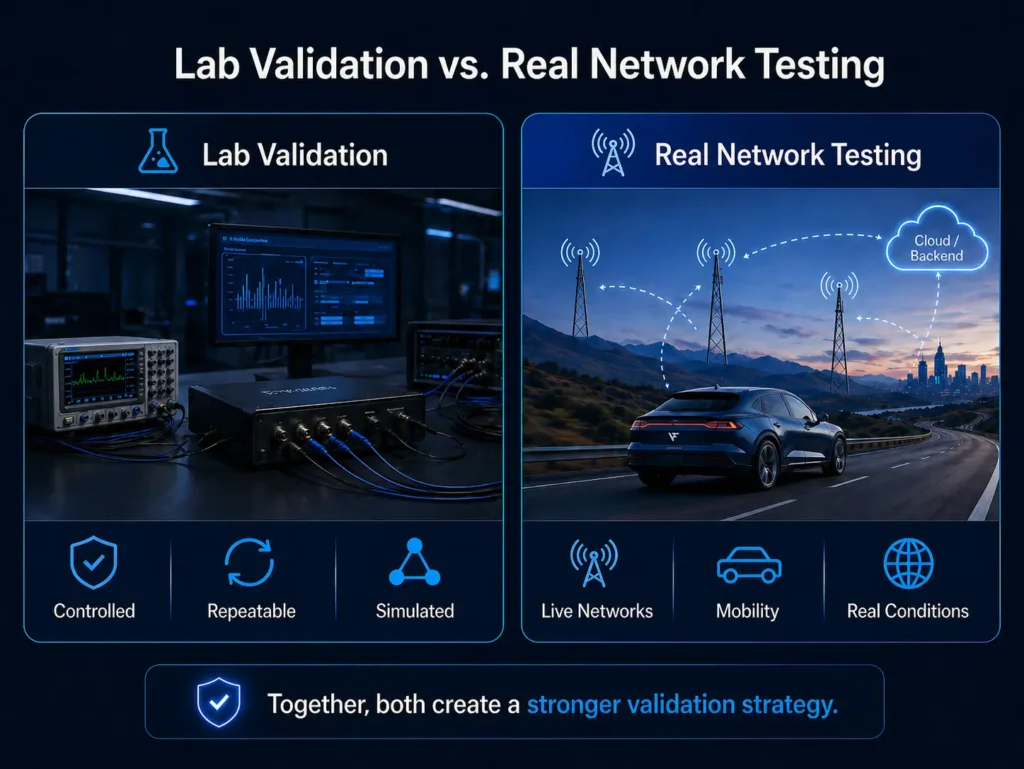
Lab validation remains essential. It helps engineering teams verify functionality, repeat test cases, and validate core system behavior. But for connected vehicles, lab validation alone does not show the full picture.
To prepare for real-world operation, OEMs need to understand how vehicle connectivity performs across live networks, operators, regions, and deployment environments.
This is where real network testing bridges lab validation with real-world connectivity excellence.
Why Real Network Testing Matters
Vehicle connectivity is not a single-network scenario.
A connected vehicle may move between coverage zones, switch network cells, cross borders, roam between operators, or communicate with backend systems under different network conditions. Each of these situations can influence connectivity performance.
For OEMs, this matters because connected vehicle services rely on consistent communication between three main layers:
- The vehicle
- The mobile network
- The OEM cloud or backend
3GPP describes 5G as a complete mobile system, not only a radio interface. It includes protocols and network interfaces for mobility management, session control, service provisioning, and inter-operator operation. This is why connectivity validation should look beyond the device itself and consider the full communication path.
Real network testing helps OEMs evaluate how connectivity behaves in real deployment conditions, including:
- Network switching
- Roaming behavior
- Signal quality variation
- Data session continuity
- Vehicle-to-cloud communication
- Backend response behavior
The result is better visibility before market rollout.
Lab Validation and Real-World Testing Work Together
Lab validation and real network testing are not competing approaches. They support each other.
Lab validation provides control. It allows teams to test known conditions, repeat scenarios, and verify expected system behavior.
Real network testing adds field confidence. It shows how the same system behaves when exposed to live networks, mobility, operator behavior, and real deployment conditions.
A strong validation process should combine both:
- Validate core functionality in the lab
- Define real-world connectivity scenarios
- Test across live networks and regions
- Capture vehicle, network, and backend data
- Analyze system behavior
- Improve readiness before deployment
This approach supports OEM teams’ move from controlled validation to real-world confidence.
What Real Network Testing Validates
Connected vehicle performance depends on the interaction between vehicle systems, mobile networks, and backend platforms.
At the vehicle level, OEMs need to validate the OCU/TCU, firmware, embedded software, connectivity module, SIM/eSIM behavior, and vehicle-side applications.
At the network level, they need to evaluate LTE/5G connectivity, roaming, handover behavior, operator environments, and signal quality.
At the cloud level, they need to validate APIs, OTA systems, diagnostics services, data flows, and backend response times.
This means real network testing should focus on end-to-end behavior, not only whether the vehicle is connected.
Important validation areas include:
- Vehicle-to-cloud communication
- Network registration
- Roaming behavior
- Handover behavior
- OTA session stability
- Diagnostic data exchange
- Service recovery after network changes
This gives OEM teams a clearer understanding of how the connected platform will perform once deployed.
Hardware-Enabled Testing Across Locations
Testing connectivity at a single location is not enough for global vehicle programs.
OEMs need to understand how systems behave across different areas, operators, and market conditions. This is especially important for connected vehicle platforms that will be launched across multiple regions.
To support this, Horizon Connect is developing a hardware-enabled testing solution that helps facilitate real network testing across different locations and deployment areas.
The goal is to make validation more scalable. Instead of relying only on repeated manual field testing, OEM teams can use remote and hardware-enabled setups to test connectivity behavior in real network environments more efficiently.
This direction builds on Horizon Connect’s Remote Connectivity Lab, which enables remote control of connectivity test benches, online and offline test execution, automated data extraction from connected OCUs, and automated reporting.
For OEMs, this supports:
- Faster validation cycles
- Testing across different regions
- Reduced manual effort
- Better comparison between network environments
- Stronger preparation for market rollout
In simple terms, hardware-enabled real network testing supports OEMs in validating connectivity closer to the way vehicles will operate after deployment.
Global Testing with SGP.32 and eIM
As OEMs scale connected vehicle platforms globally, eSIM management becomes an important part of connectivity readiness.
Horizon Connect is also working on a global testing concept using SGP.32 and eIM-based workflows can support global testing concepts by enabling validation of eSIM provisioning, profile lifecycle management, operator profile behavior, and regional deployment scenarios.
GSMA SGP.32 defines technical specifications for remote provisioning and management of eSIM in IoT devices, including network-constrained and user-interface-constrained devices.
SGP.31 defines the eSIM IoT architecture and includes architecture elements such as eUICC, SM-DP+, eIM, IPA, SM-DS, and operator components.
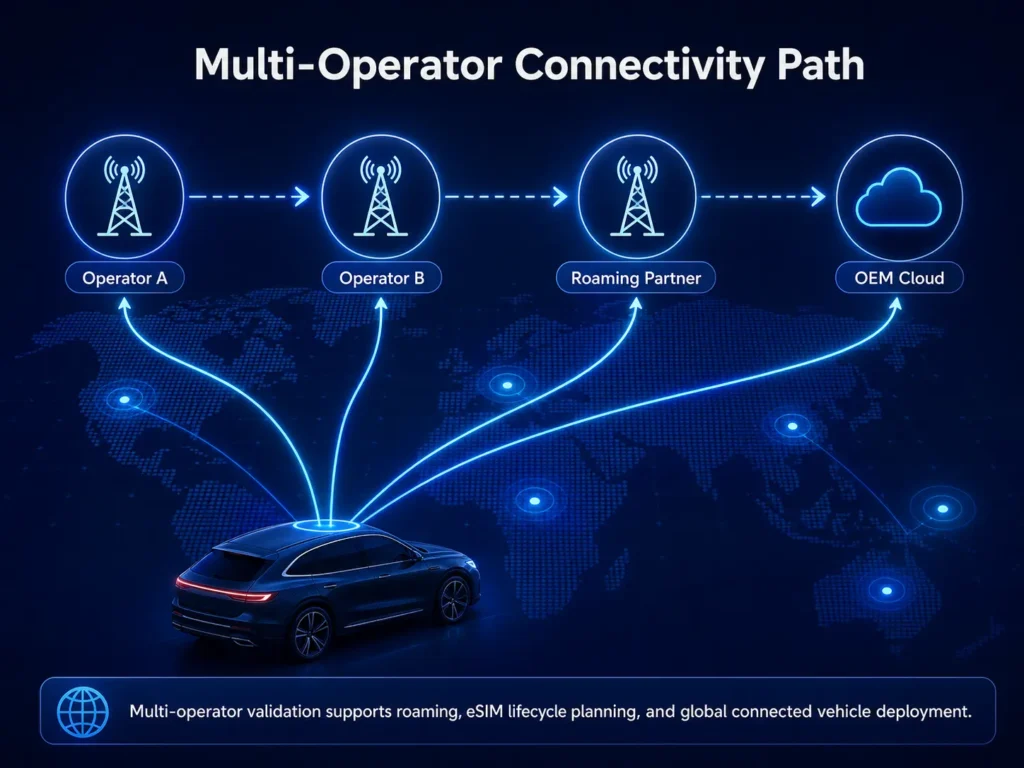
For OEMs, this can support more flexible validation across:
- Operator profiles
- Roaming scenarios
- Regional connectivity conditions
- eSIM lifecycle workflows
- Multi-market rollout planning
The value is clear: OEMs can prepare connected vehicle platforms for global deployment with more flexibility and stronger validation coverage.
Supporting Faster Market Rollout
Real network testing can support faster and more confident market rollout by supporting OEMs identify connectivity behavior earlier, before deployment at scale.
Instead of discovering issues late in the rollout phase, OEM teams can validate earlier across realistic operating conditions.
This supports:
- More stable connectivity: Systems can be tested across live networks and changing environments.
- More reliable data exchange: Vehicle-to-cloud communication can be validated end-to-end.
- Better deployment readiness: OEM teams can compare behavior across regions and operators.
- Faster rollout confidence: Hardware-enabled and remote testing can reduce manual effort and improve scalability.
This is especially important as vehicles become more software-defined and more dependent on connected services.
Horizon Connect’s Role
Horizon Connect supports OEMs with real-world connectivity validation across vehicle, network, and backend systems.
The focus is to support OEM teams in bridging lab validation with real deployment behavior through:
- Real network testing
- Connectivity validation
- Remote test execution
- Hardware-enabled testing setups
- Vehicle-to-cloud validation
- Roaming and operator scenario testing
- SGP.32 and eIM-based global testing concepts
- Automated reporting and engineering insights
From validation to deployment, Horizon Connect supports OEMs prepare connected vehicle platforms for real-world operation.
Conclusion
Lab validation is essential, but connected vehicle performance is proven in real-world conditions.
Real network testing supports OEMs in understanding how connectivity behaves across live networks, operators, regions, and deployment scenarios. It supports better engineering decisions, stronger rollout readiness, and more reliable connected vehicle services.
With remote validation, hardware-enabled testing, and future-ready global testing concepts using SGP.32 and eIM, Horizon Connect is supporting OEMs move from controlled validation to real-world connectivity excellence.