
An MVNO platform for OEMs is becoming a critical enabler for navigating the complexity of global vehicle connectivity. As vehicles evolve into software-defined platforms, connectivity must be flexible, scalable, and fully controllable. By leveraging eSIM technology and multi-network orchestration, this setup allows automakers to dynamically swap carriers, ensure seamless global coverage, and manage the entire lifecycle of software-defined vehicles without requiring physical hardware changes.
The Shift in Automotive Connectivity
The automotive industry is undergoing a massive transformation. As vehicles evolve into sophisticated rolling computers, their underlying connectivity must adapt. Traditional, single-carrier telecom models simply struggle to keep pace with the constant data exchange required for over-the-air updates, advanced driver assistance systems, and consistent global services.
Relying on a single network provider creates bottlenecks and vulnerabilities. An MVNO platform breaks these limitations, giving automakers direct control over their connectivity strategy and freeing them from telecom vendor lock-in.
The Challenge of Global Deployment
Launching connected cars globally creates significant operational friction. Automakers face a patchwork of different mobile operators, varying technical standards, and strict local regulations. Dealing with multiple telecom vendors leads to complex roaming agreements and fragmented workflows.
Furthermore, drivers expect their infotainment, navigation, and emergency systems to work all the time flawlessly. Guaranteeing this reliability becomes incredibly difficult when vehicles cross borders or enter dead zones tied to a specific carrier’s limited footprint. Always-on connectivity is no longer a luxury; it is a baseline requirement.

Core Technology Enablers Behind an MVNO Platform for OEMs
A modern MVNO platform solves these connectivity challenges by leveraging core technologies:
eSIM and Remote SIM Provisioning
eSIM technology eliminates the need for physical SIM replacements. GSMA-compliant remote provisioning allows OEMs to execute remote operator switching, instant activations, and scalable fleet deployments completely over-the-air.
Multi-Network Orchestration
Vehicles must stay connected seamlessly. An MVNO platform for OEMs allows vehicles to dynamically connect to the best-performing network, the most cost-efficient operator, or the most reliable signal in real time, depending on predefined business rules.
Cloud-Based Connectivity Platforms
A centralized, cloud-native architecture provides real-time analytics, automated policy control, and comprehensive subscription lifecycle management from a single interface.

How Horizon Connect Empowers OEMs
Horizon Connect delivers a structured, scalable, and purpose-built MVNO strategy for the automotive sector. Operating as an MVNO, Horizon Connect provides full eSIM lifecycle management tailored specifically to OEM requirements.
Our unified orchestration approach includes:
- Carrier-of-Choice Enablement: Multi-network provisioning that decouples hardware from network providers.
- Global Compliance: Seamless subscription and profile management across borders, ensuring market-specific certifications are maintained.
- Ecosystem Integration: Direct integration with OEM backend systems, connectivity platforms, and mobile networks.
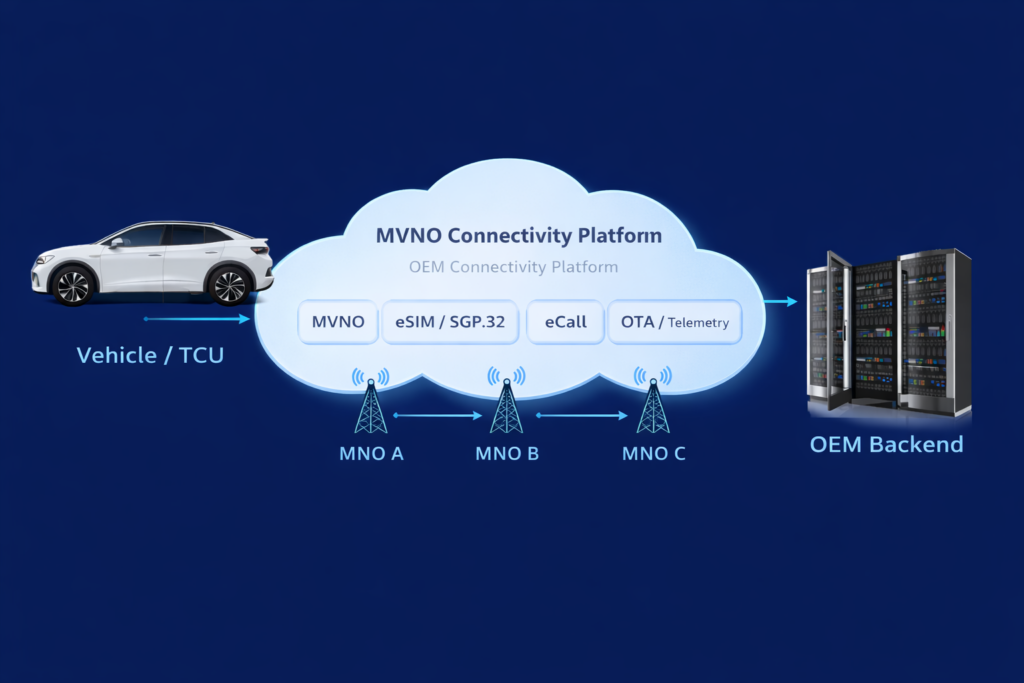
The Strategic Benefits of an MVNO Platform for OEMs
An MVNO platform is not just an IT solution; it is a strategic control layer for OEM connectivity. By leveraging a multi-network platform, OEMs can:
- Decouple Connectivity from Hardware: Make future-proof hardware decisions without worrying about carrier lock-in.
- Ensure a Consistent User Experience: Guarantee reliable connections for drivers, regardless of geography.
- Optimize Costs at Scale: Route data traffic dynamically based on the most cost-effective carrier agreements.
- Unlock New Revenue Streams: Enable premium connected services, on-demand features, and seamless software monetization.
Conclusion
The transition to software-defined vehicles makes connectivity a core strategic asset. An MVNO platform equips OEMs with the tools to gain complete control over global connectivity, reduce operational complexity, and scale efficiently.
As the automotive industry’s digital transformation deepens, carrier-of-choice flexibility will separate market leaders from the rest. MVNO platforms will be the engine driving that shift.