

AI diagnostics is becoming essential for connected vehicle development. Modern vehicles depend on continuous interaction between in-vehicle systems, mobile networks, backend platforms, cloud services, APIs, eSIM profiles, and real-time operational data. As software-defined vehicles become more complex, engineering teams need faster and more structured ways to detect issues, understand root causes, and restore services.
This is where AI diagnostics becomes a practical engineering advantage. Instead of relying only on manual commands, disconnected tools, and time-consuming log reviews, AI-driven diagnostic workflows can connect automation, guided analysis, and system insight into one structured process.
For Horizon Connect, this direction is represented through the Intelligent Assistant System (IAS), an AI-powered assistant designed to support automotive connectivity testing and operations. IAS combines automated actions, guided diagnostics, and log and trace analysis to help teams reduce manual effort, improve troubleshooting consistency, and accelerate diagnostic workflows.
Why AI diagnostics matters for connected vehicles
Modern connectivity problems rarely come from one layer only. A single issue can involve the vehicle module, mobile network behavior, backend APIs, SIM or eSIM profile status, IMS registration, roaming conditions, cloud communication, or operational data. Finding the root cause requires visibility across the full connected vehicle stack. As shown in Figure 1, effective AI diagnostics depends on analyzing the complete connectivity chain rather than treating each layer as an isolated system.
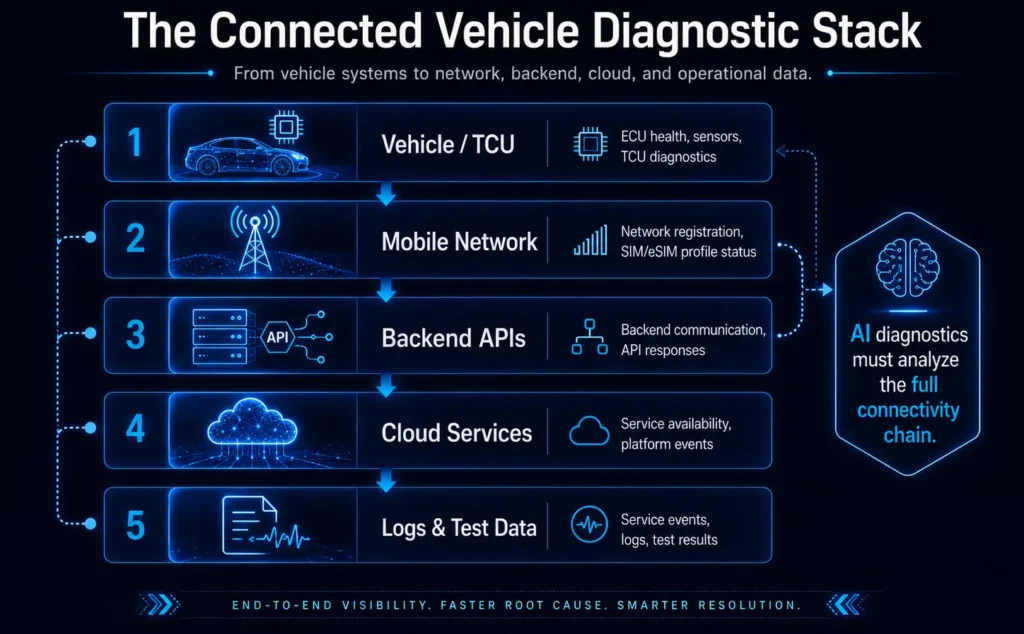
This complexity becomes even more important under real deployment conditions. Vehicles operate across changing signal quality, network switching, roaming scenarios, operator configurations, and regional network behavior. Validation therefore needs to reflect real-world operating conditions, because connectivity behavior can change while the vehicle is in motion.
Industry trends point in the same direction. GSMA identifies connected cars and automotive IoT as important areas where mobile networks enable intelligent vehicle operations and connected vehicle services. GSMA’s SGP.32 eSIM IoT specification also supports the remote provisioning and management of eUICCs in IoT devices, making it relevant for scalable connectivity operations in connected vehicle and broader IoT deployments.
For automotive connectivity teams, the value of AI diagnostics is not simply the use of AI. The real value is turning scattered diagnostic activity into a repeatable, guided, and measurable workflow.
From manual troubleshooting to intelligent workflows
Traditional troubleshooting in connected vehicle programs often includes repeated backend recovery steps, manual command execution, separate dashboards, disconnected data sources, and long diagnostic cycles. These workflows can slow down engineering decisions, especially when multiple systems need to be checked before the real issue becomes clear.
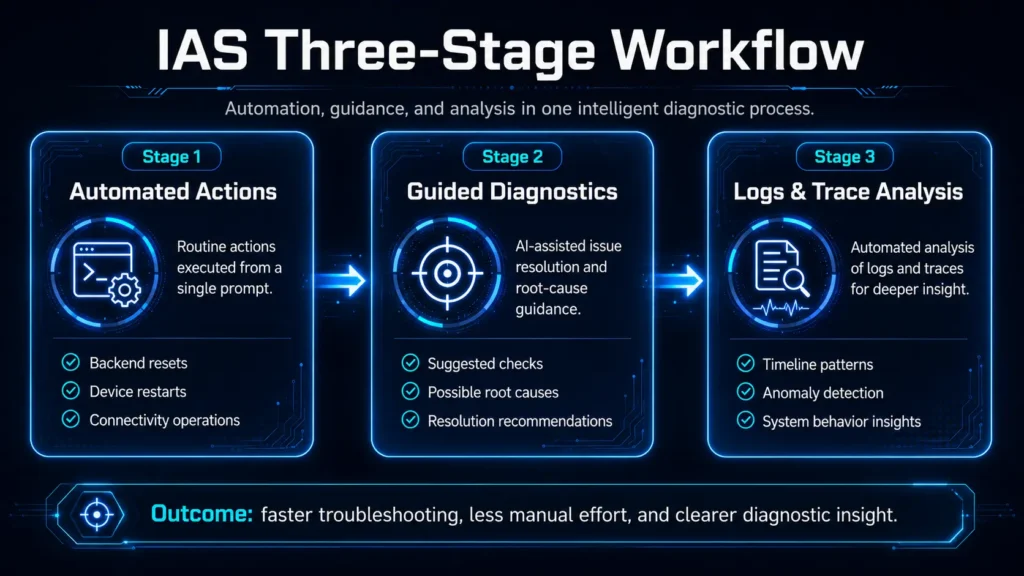
AI diagnostics helps teams move from reactive investigation to structured resolution. Instead of asking engineers to manually check every possible failure point, an intelligent assistant can support the workflow in three ways: executing routine actions faster, guiding engineers toward possible root causes, and analyzing logs and traces to show what happened across the system timeline.
This three-stage model is central to the IAS approach. Stage 1 focuses on automated actions, Stage 2 supports guided diagnostics, and Stage 3 enables logs and trace analysis.
AI diagnostics Stage 1: automated action execution
Many troubleshooting workflows begin with repetitive but necessary actions, such as resetting backend sessions, restarting devices, checking connectivity status, or running recovery and maintenance tasks. These actions are important, but they also consume engineering time when performed manually.
In the IAS model, Stage 1 supports the automated execution of routine operations through a single prompt. This can include backend resets, device restarts, connectivity operations, recovery tasks, and maintenance actions.
This does not replace engineers. It reduces repetitive manual steps so engineers can focus on interpreting results, validating behavior, and making decisions. In connected vehicle validation, this is especially useful because the same recovery sequence may need to be repeated across different test cases, mobile networks, vehicle modules, firmware versions, or market configurations.
AI diagnostics Stage 2: guided issue resolution
After routine actions are executed, the next challenge is interpreting the system response and narrowing down the possible root cause. In connected vehicle environments, issues may be linked to mobile network behavior, backend communication, APN configuration, IMS registration, SIM or eSIM profile status, roaming conditions, or device-side communication.
IAS Stage 2 supports this process through guided diagnostics. It helps structure the investigation path by suggesting relevant checks, highlighting possible failure areas, and guiding engineers toward potential root causes.
This is important because connected vehicle diagnostics often requires cross-domain knowledge. A telecom issue may appear as a backend issue, while a backend timeout may be triggered by changing radio conditions. A vehicle-side connectivity failure may also depend on roaming behavior, operator configuration, or profile status.
By organizing the diagnostic workflow, AI diagnostics helps engineers move from symptoms to possible causes more efficiently. Instead of checking each layer manually, teams can follow a guided path that supports faster analysis and more consistent troubleshooting.
AI diagnostics Stage 3: logs and trace analysis
The deepest diagnostic value often comes from logs and traces. These data sources show what happened, when it happened, and how one event influenced another. Manual log review can be slow, especially when teams need to compare timestamps across vehicle data, backend events, connectivity records, and test results.
IAS Stage 3 focuses on automated logs and trace analysis. This stage is designed to help engineering teams correlate events, identify timeline patterns, detect anomalies, and better understand system behavior.
This aligns with the broader direction of connected vehicle analytics, where data from vehicles, networks, backend systems, and operational environments can be analyzed together to improve visibility and decision-making. AI-supported log analysis can also improve consistency because similar diagnostic logic can be applied across comparable test cases.
For engineering teams, this means fewer blind spots. Instead of reviewing logs only after an issue escalates, AI diagnostics can help teams identify recurring patterns earlier when sufficient logs and traces are available.
The role of AI diagnostics in software-defined vehicle development
Software-defined vehicles depend on fast development cycles, reliable connectivity, and continuous validation. As vehicle functions become more connected, troubleshooting speed becomes directly linked to release confidence.
Automated validation environments already play an important role in this process. Remote test benches, automated data extraction, online and offline test execution, and structured reporting help engineering teams reduce manual effort and improve repeatability. IAS extends this approach by adding intelligent diagnostic support on top of automated testing and operational workflows.
This is especially relevant as regulatory, software, and cybersecurity requirements continue to increase. UNECE states that UN Regulations on cybersecurity and software updates establish clear performance and audit requirements for vehicle manufacturers. In this environment, diagnostic workflows should not only be fast. They should also be structured, traceable, and repeatable.
AI diagnostics can support that goal by helping teams document issue paths, standardize troubleshooting actions, and generate clearer diagnostic evidence.
Business value for OEMs and engineering teams
The practical value of AI diagnostics can be seen in four areas.
- Reduced manual effort: Repetitive commands and recovery actions can be automated, allowing engineers to spend more time on validation and decision-making.
- Faster troubleshooting cycles: Guided workflows help teams move more quickly from symptoms to possible root causes.
- Better consistency: AI-supported diagnostic logic can reduce variation between engineers, test environments, project phases, and repeated issue scenarios.
- Deeper system understanding: Automated logs and trace analysis can reveal patterns across vehicle, network, backend, and data layers.
For automotive connectivity programs, this creates a more structured way to handle diagnostic complexity. The goal is not only to solve individual issues faster, but also to make troubleshooting more repeatable across teams, projects, and deployment environments.
McKinsey notes that generative AI can improve automotive and industrial software development processes when integrated properly into existing engineering procedures. This reinforces the importance of using AI as part of a structured engineering workflow, not as an isolated tool.
Conclusion: AI diagnostics as an engineering enabler
AI-driven efficiency in connected vehicle diagnostics is not about replacing expert engineers. It is about supporting them with a smarter, more structured workflow.
As connected vehicle systems become more complex, traditional troubleshooting can become too slow, manual, and fragmented. Engineering teams need automated action execution, guided issue resolution, and faster analysis of logs and traces to keep development and validation workflows moving efficiently.
With IAS, Horizon Connect brings these capabilities into one assistant-driven model. The result is a diagnostic workflow designed to help automotive connectivity teams reduce repetitive effort, follow clearer root-cause paths, and gain better visibility across the connected vehicle stack.
For OEMs and mobility operators, AI diagnostics can become an important enabler for reliable connected vehicle development, validation, and operation.