

Global vehicle connectivity is no longer simply a question of selecting a mobile operator and enabling roaming. For an automotive OEM deploying the same vehicle platform across multiple countries, connectivity must continue to work while mobile networks, coverage, roaming conditions, operator requirements and local deployment rules change from market to market.
That makes scale an architecture and lifecycle-management challenge.
A vehicle may leave the factory with one hardware configuration, but during its lifetime it may operate across different operators, countries, network technologies and service environments. The connectivity strategy therefore needs to support much more than access to a mobile network. It must define how operators are selected, how eSIM profiles are provisioned, when connectivity can switch between networks and how the vehicle remains integrated with the OEM backend.
This is why scalable automotive connectivity increasingly depends on combining Multi-MNO strategies, eSIM lifecycle management, SGP.32, connectivity orchestration and real-world validation within one operating model. Horizon Connect’s Multi-operator framework follows exactly this principle: multiple networks create value when they can be managed as one system.
Why global vehicle connectivity gets harder at scale
Connectivity that performs well in one country cannot automatically be assumed to behave in the same way everywhere else.
Mobile operators have different network footprints. Roaming relationships vary. Coverage conditions change. Network configuration and regional requirements can also influence how vehicle services behave after deployment.
For an OEM, these differences affect far more than the infotainment connection. Connected vehicle platforms can depend on mobile connectivity for telematics, remote services, diagnostics, software communication, backend access, emergency functions and over-the-air workflows.
The GSMA describes reliable network access as increasingly important as vehicles evolve into intelligent, data-driven systems and highlights interoperability across markets as a key requirement for connected vehicle services.
The challenge therefore becomes:
How can an OEM maintain one global vehicle architecture while adapting connectivity to each local market?
The answer is not necessarily one global operator. It is a connectivity framework capable of working with several operators without forcing the OEM to redesign the vehicle platform for every country.
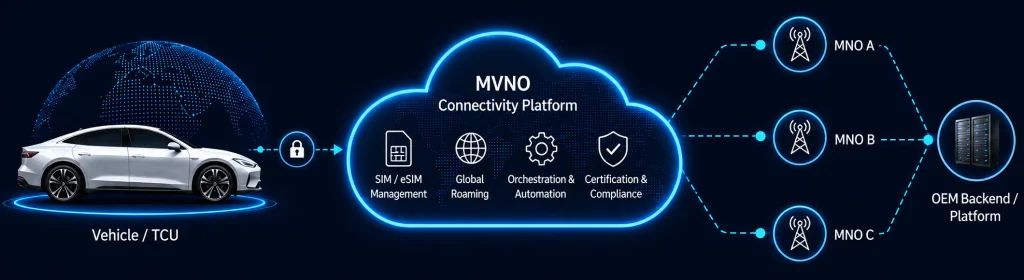
A scalable connectivity architecture separates the vehicle platform from market-specific operator complexity. Instead of building an independent connectivity model for each country, the OEM maintains a common vehicle and backend architecture while operator access, profiles and connectivity policies can be adapted to individual markets.
Building a Multi-MNO strategy for global vehicle connectivity
A Multi-MNO approach gives an OEM access to more than one mobile network.
But the real value is not simply having several operators available.
The strategy must determine which operator should be used, where it should be used and under which conditions connectivity should change.
Horizon Connect’s Multi-operator framework identifies several elements that need to be defined:
- operator fit for each target market;
- eSIM profile provisioning and management;
- network-switching and fallback rules;
- integration with the TCU, cloud and OEM backend;
- performance and cost governance;
- market-specific compliance and lifecycle management.
eSIM changes connectivity from hardware to lifecycle management
Traditional physical SIM models make large international deployments difficult to change after production.
An embedded SIM changes that model by supporting remote subscription management. For OEMs, this means connectivity can increasingly be treated as a lifecycle capability rather than a fixed production decision.
A vehicle may remain operational for many years. During that time, operators, commercial agreements and connectivity requirements can change.
The ability to remotely manage profiles therefore becomes strategically important.
The GSMA’s eSIM specifications provide a standardized architecture for remote SIM provisioning. For IoT deployments, the current SGP.32 v1.3 specification covers remote provisioning and management of eUICCs, the IoT eSIM architecture, interfaces and security functions.
How SGP.32 supports global vehicle connectivity
SGP.32 is particularly relevant to large-scale connected devices because it provides a framework for remote eSIM provisioning and lifecycle operations without requiring physical access to the SIM.
For automotive programs, this supports an important shift:
from configuring connectivity at production time to managing connectivity throughout the vehicle lifecycle.
Horizon Connect’s SGP.32 readiness work focuses on areas including profile lifecycle management, SM-DP+ integration, Multi-MNO strategy, backend orchestration, device readiness, interoperability and regional deployment planning.
The GSMA also notes that SGP.32 is intended to reduce the complexity of provisioning and managing MNO profiles for IoT applications using eSIM technology.
What OEMs should define before global deployment
Successful global vehicle connectivity requires decisions to be made before individual market rollouts become fragmented.
OEM connectivity programs should define:
- Target-market operator strategy
Determine which MNOs are suitable for each region. - eSIM architecture and lifecycle model
Define how profiles are provisioned, managed and changed. - Multi-MNO policies
Establish network-selection, switching and fallback rules. - Vehicle and backend integration
Align the TCU, connectivity layer, cloud services and OEM backend. - Market readiness and compliance
Address local network, certification and deployment requirements. - Validation strategy
Verify connectivity across operators, roaming situations and real operating conditions.
The earlier these areas are aligned, the easier it becomes to reuse one connectivity framework across multiple vehicle programs and markets.
How Horizon Connect enables global vehicle connectivity
Horizon Connect supports OEMs across the connectivity lifecycle — from architecture and operator strategy through integration, validation and deployment.
Our approach combines:
- Multi-MNO and MVNO strategy: Operator selection, carrier-of-choice concepts and scalable multi-network architectures.
- eSIM and SGP.32 readiness: Profile lifecycle strategy, provisioning architecture and ecosystem integration.
- Connectivity-platform integration: Alignment between vehicle systems, mobile networks and OEM backend environments.
- Market-specific deployment support: Preparing connectivity configurations and requirements for individual regions.
- Real-network validation: Testing connectivity behavior across live networks, mobility conditions and deployment scenarios.
Conclusion
Scaling connected vehicles across countries requires more than roaming and more than a global SIM contract.
Global vehicle connectivity depends on how effectively OEMs can coordinate mobile operators, eSIM profiles, connectivity policies, backend systems and validation throughout the vehicle lifecycle.
Multi-MNO architectures provide operator flexibility. eSIM and SGP.32 enable remote lifecycle management. Connectivity platforms bring these elements together. And real-network validation ensures that the architecture works outside the lab.
For OEMs, this creates a path toward one scalable connectivity framework that can adapt as markets, networks, and vehicle programs evolve.
Horizon Connect helps automotive OEMs define, integrate, validate, and operate connectivity architectures designed for global deployment.
Explore Horizon Connect’s connectivity solutions or contact our team to discuss your global vehicle connectivity strategy.