
Saudi Arabia is moving fast in connected mobility.
But NG-eCall is not just a feature — it’s a system.
As the GCC accelerates investments in smart mobility, 5G infrastructure, and connected vehicles, emergency communication is entering a new phase. NG-eCall, powered by IP-based networks, is becoming a key requirement for next-generation vehicle platforms.
For OEMs, the challenge is no longer just implementation.
It’s ensuring emergency calls work reliably across networks, countries, and regulatory environments—especially in fast-evolving markets like the GCC.
NG-eCall: A System, Not a Feature
Traditional eCall systems were largely self-contained within the vehicle. NG-eCall fundamentally changes this approach.
Instead of relying on voice-based communication, NG-eCall operates over LTE and 5G networks, enabling faster call setup and more reliable data transmission.
However, the real transformation lies in architecture.
Emergency communication now depends on a full chain:
- Vehicle (TCU and onboard systems)
- Mobile network infrastructure
- IMS (IP Multimedia Subsystem) core
- Public Safety Answering Point (PSAP)
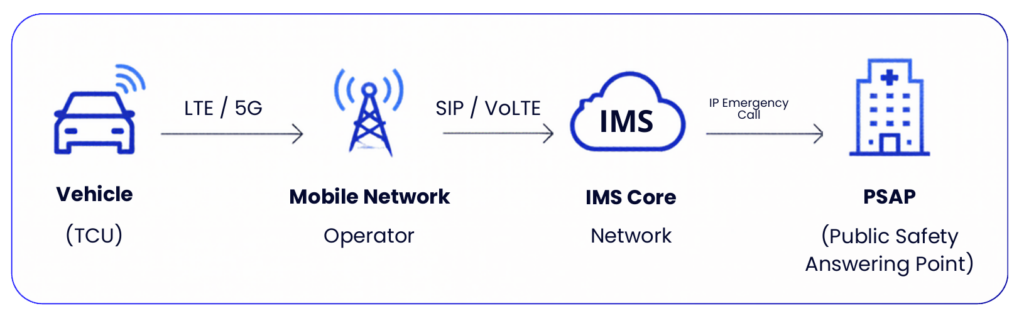
If one layer fails, the entire system fails.
This makes NG-eCall a distributed system, where performance depends on seamless interaction between automotive and telecom domains.
From eCall to NG-eCall: A Structural Shift
The evolution of emergency call systems reflects the broader transition toward connected vehicles.
- Legacy eCall systems relied on circuit-switched voice channels with limited flexibility.
- Private eCall introduced LTE/5G connectivity but remained dependent on service providers.
- NG-eCall represents a full shift to IP-based communication, built on IMS and designed for scalability.
This transition marks a key change: Emergency communication is now network-centric, not vehicle-centric.
IMS Integration: Where Complexity Begins
At the core of NG-eCall lies the IP Multimedia Subsystem (IMS)—a critical component of LTE and 5G networks.
IMS enables IP-based emergency communication, but it also introduces significant challenges:
- SIP signaling compatibility
- VoLTE emergency call handling
- Network interoperability
- Cross-border roaming behavior
- PSAP communication alignment
The complexity increases because telecom networks are not identical across regions.
A system that works in one country may behave differently in another.
This makes IMS integration not just a technical task, but a safety-critical engineering challenge.
Compliance Is Only the Starting Point
NG-eCall must align with multiple global frameworks, including European regulations, ETSI standards, 3GPP specifications, and UNECE requirements.
However, compliance alone is not enough.
- Compliance ensures approval.
- Validation ensures performance.
OEMs must ensure that systems function reliably under real-world conditions:
- Weak or unstable network coverage
- Roaming between operators
- Variations in network behavior
- Emergency call prioritization
Without this level of validation, even compliant systems can fail in practice.
Expanding NG-eCall into the GCC
The GCC region—including Saudi Arabia, UAE, Qatar, and neighboring markets—is rapidly emerging as a hub for connected mobility.
Driven by national transformation programs, the region is investing heavily in:
- Smart mobility ecosystems
- Digital infrastructure
- 5G connectivity
- Connected and autonomous vehicle technologies
For OEMs, this creates a new challenge:
Deploy NG-eCall systems that are globally compliant but locally adaptable.
Saudi Arabia as a Leading Example
Saudi Arabia is at the forefront of this transformation.
Under Vision 2030, the Kingdom is accelerating digitalization, infrastructure modernization, and mobility innovation.
At the same time, regulatory frameworks are becoming more structured and rigorous.
The Saudi Standards, Metrology and Quality Organization (SASO) defines requirements for:
- Product conformity
- Certification processes
- Telecom approvals
For OEMs, entering the Saudi market requires alignment across technology, regulation, and telecom ecosystems.
Horizon Connect: Enabling NG-eCall Across the GCC
Horizon Connect is expanding its emergency call ecosystem across the GCC, with Saudi Arabia as a key focus.
This includes:
- Supporting eCall and authority communication system deployment by 2027
- Aligning with global NG-eCall standards and architecture
- Integrating LTE and 5G-based emergency communication systems
The approach goes beyond implementation.
Horizon Connect focuses on system-level integration, bridging:
- Automotive platforms
- Telecom networks
- Regulatory frameworks
With German engineering standards, the focus is on delivering:
- Reliability
- Precision
- Scalability across markets
This includes support for advanced connectivity frameworks such as eSIM remote provisioning (SGP.32), enabling secure and scalable communication across vehicle platforms.
With strong telecom expertise and German engineering standards, Horizon Connect ensures reliable and future-ready solutions.
Local Presence: A Critical Success Factor
Technology alone is not enough to succeed in the GCC.
OEMs must coordinate with:
- Regulatory authorities
- Telecom operators
- Certification bodies
This is where many delays occur.
Horizon Connect supports OEMs with:
- Local coordination and representation
- Regulatory alignment
- Real-time issue resolution
EV Auto Show Riyadh: From Presence to Partnership
Horizon Connect’s participation in the EV Auto Show Riyadh reflects its growing role in the region.
The event enabled:
- Direct engagement with OEMs and stakeholders
- Insights into regional challenges
- Showcasing of NG-eCall expertise
This presence strengthens Horizon Connect’s position as a trusted partner in the GCC mobility ecosystem.
End-to-End Validation: Where Most Failures Occur
NG-eCall systems operate across multiple interconnected layers.
Most failures do not occur within individual components—but at the interfaces between systems.
Typical risks include:
- SIP signaling mismatches
- Roaming-related failures
- Network prioritization issues
- Inconsistent PSAP behavior
This makes end-to-end validation essential.
Testing must cover:
- Multiple networks
- Cross-border scenarios
- Real-world operating conditions
Conclusion
NG-eCall is becoming a global standard for emergency communication in connected vehicles.
At the same time, the GCC is emerging as a key region for mobility innovation.
For OEMs, success depends on more than implementation.
It requires:
- System-level engineering
- Telecom integration expertise
- Real-world validation
- Regional understanding
With the right approach, NG-eCall becomes more than a compliance requirement.
It becomes a strategic enabler for global expansion.